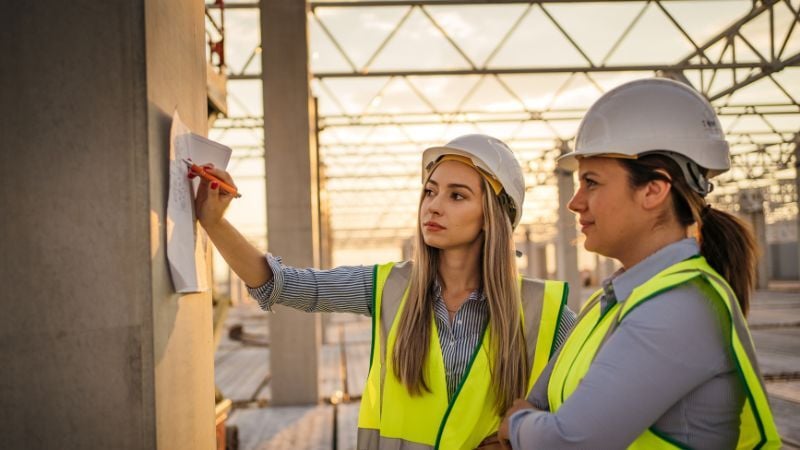
The construction industry has traditionally been perceived as heavily male-populated, but women have been making significant inroads in recent decades. In a special episode of Constructive Conversations, host Eddie Thompson sat down with three accomplished women in the industry to discuss their experiences, challenges, and the evolving landscape for women in construction.
Meet the Trailblazers
Blair Williamson, owner of SL Williamson Company, a third-generation asphalt pavement and road construction company in Charlottesville, Virginia, began her career as an architect before joining her father's business 34 years ago. "I called him from my architecture office and said, 'I want to come to work for you,'" Blair recalls. "He said, 'Yeah, okay. But what would you do here?' And I said, 'Well, I guess I'll start shoveling asphalt,' which I did."
Betty Howard, owner of Bruce Howard Contracting in Charles City, Virginia, transitioned from finance to construction in 1998. "I was working in finance and I was able to see construction companies where I thought, 'Okay, I can make a lot more money starting my own business,'" Betty shares. She started small with services like grading driveways and cutting grass before expanding into commercial services, excavating, grading, and utility work.
Carla Brown, a director at Brown Edwards and Company with 19 years of experience working in construction and public accounting, provides valuable insights from the financial side of the industry. Carla began her career at a smaller firm in Virginia Beach where most of their work involved contractors in the Hampton Roads Tidewater area.
Challenges and Growth
When asked about challenges they faced entering the traditionally heavy male-populated construction field, their experiences varied. Blair acknowledges that starting at the bottom and having the company name helped smooth her path. "I didn't necessarily face a huge amount of challenge... It probably was because I had an architecture background, so I had some familiarity with construction methods and means."
Betty's experience differed as her company grew from small residential jobs to larger commercial projects. "At the very beginning, I don't think I had much problem because we were doing such small jobs... But as we started to grow and I had to go to all these pre-bids and things like that, it wasn't as welcoming. And most of the times I was the only woman in there."
Both women emphasized the importance of competence and authenticity. "I learned early in my career not to fake it. If you didn't know something, just say, 'I don't know what we're talking about,' because if you did try to fake it, then you would lose credibility," Blair advises.
Betty concurs: "I think when they started to notice that I knew what I was talking about, I wasn't just showing up out there. I knew what equipment we would need. I knew how we had to do a takeoff. I knew how many people we would need and what equipment... she knows her stuff and she's tough."
The Changing Landscape
All three women have witnessed significant changes in the industry over their careers. "There's a lot more women in construction now, own their own business, or work in than there was when I started in '98. I didn't see another one, tell you the truth, hardly," Betty observes.
Blair remembers being the only woman at industry association meetings for many years. "I remember at association meetings being the only woman, or there was one other woman... And then she sold her company. And then I was the only one for many years. And I was just looking around recently at an association meeting and... it's not even, but we're gaining ground. We are definitely gaining ground."
Opportunities and Support
The National Association of Women in Construction (NAWIC) plays a crucial role in supporting women in the industry. Carla, who serves as vice president of the Roanoke Valley chapter, explains that Women in Construction Week features events "to draw attention and to get others to see the different areas in which women contribute to the construction industry."
These organizations provide networking opportunities across all levels of construction. "It's really for women in all levels of construction from, you know, from field crew up to CEO, C-suite kind of employee," Blair notes. "It's not, it's for everyone and every woman who might consider or is in the construction business."
Betty emphasizes the value of these connections: "That's the biggest thing about it because I run in and meet these people that are woman-owned. You know, so I try to use those companies as much as I can. And that's how I meet them through these programs."
Looking to the Future
Today, opportunities for women in construction continue to expand. Blair's company employs women in roles ranging from truck driving to quality control, where her lab is run by a woman who mentors other women. Betty has women truck drivers, project managers, and a woman heading their underground utilities division.
"I think there's a lot more acceptance," Betty observes. "I think women helping people, you know, each other. It wasn't like that before. I think people accept that a woman can be an owner and run the company, even though it's been known in the past to mostly be a male."
Advice to the Next Generation
When asked what advice they would give their younger selves, the women offered insights that extend beyond construction:
Blair: "Enjoy the ride more and try not to... I used to think, 'Oh, I'll be happy when I get this carrot.' And then I get to that level and I go, 'Oh yeah, that carrot wasn't that tasty. It must be that next one.'"
Betty: "Make sure you let people help you and work. Because don't let the business kill you. I worked so much, I was so worried about money. Just to make sure we can pay our employees, can have work. But I had to control everything."
Carla: "Don't be afraid to speak up... I let myself just be the wallflower, the person in the back of the room. When I may have had something enlightening to say or a good idea, I just let other people intimidate me... learning that it's okay to be assertive. And that's different than aggressive."
The Power of Mentorship
As the podcast concluded, the women emphasized the importance of supporting the next generation. "Don't be afraid to stick out for yourself, stand up for yourself. Also remember how you started and what you can do to help other women get started," Betty advises.
Carla agrees: "The mentorship is a great thing and so if you have the opportunity to help mentor others within your line of work to definitely do that."
From shoveling asphalt to running multi-million dollar companies, these women demonstrate that perseverance, knowledge, and mutual support can break through barriers in any industry. Their stories highlight not just the challenges women have faced in construction, but also the tremendous progress made and the bright future ahead for women in the field.
For those interested in learning more, Women in Construction Week has its own website at wicweek.org, featuring events throughout the country.